










The wrist hub
for governed
biometric
intelligence.
AXIONOVA™ Bracelet captures continuous physiology from the wrist, across optical, oxygenation, bioelectrical, thermal, and motion pathways, then sends each signal into an ALETHRA™-governed environment for source-labeled, practitioner-aware review.
More signals than
a ring can carry.
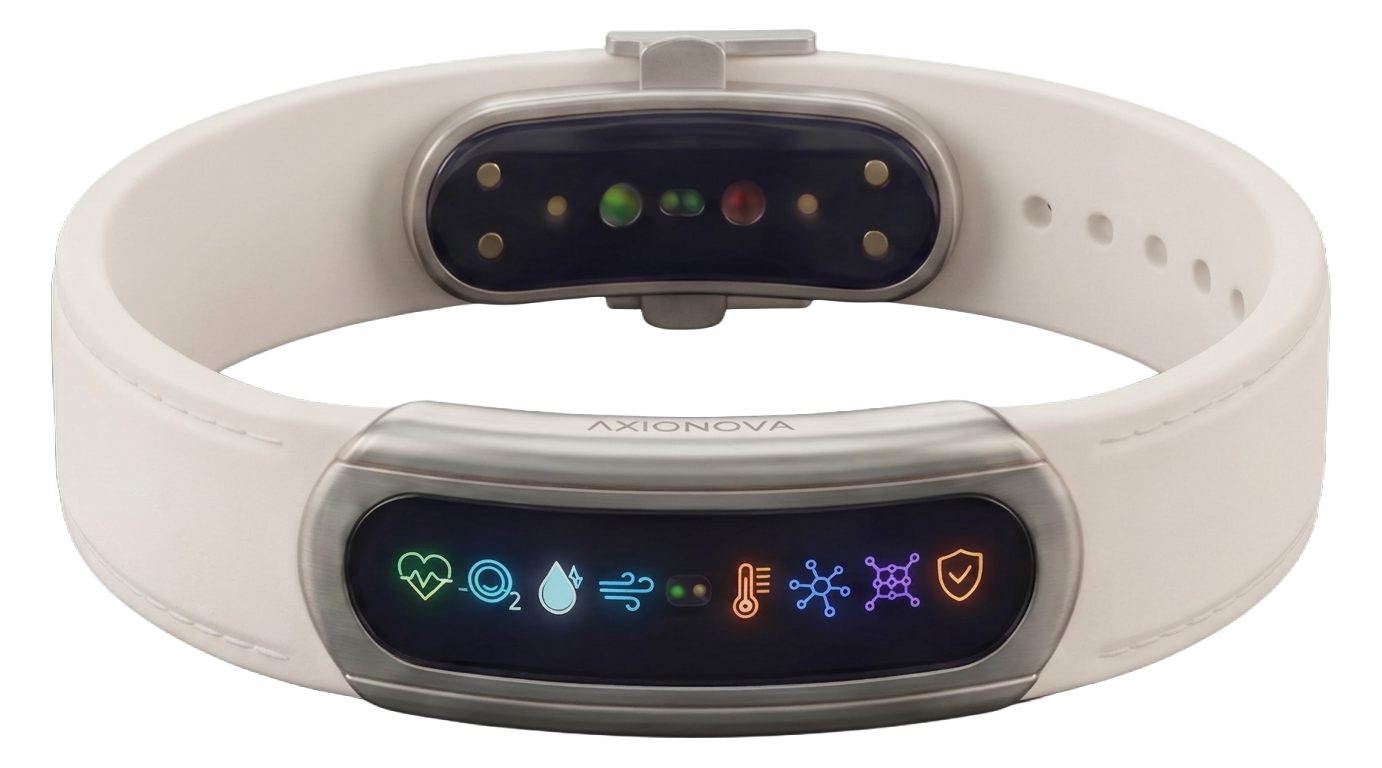
AXIONOVA™ Bracelet is the higher-capacity companion to the AXIONOVA™ Ring. The wrist gives it room for more sensors: optical PPG with an optional ECG pathway, EDA through a touch electrode, BioZ bioimpedance, skin temperature, and six-axis motion. Each reading is bound to device identity, timestamp, signal confidence, and consent, so it enters the platform as a governed source, not an unqualified conclusion.
Signals are governed
before they are read.
The bracelet captures, then ALETHRA™ applies consent partitions, quality gating, and evidence boundaries. ALETHA™ explains the trends and routes context for review, without turning wrist data into diagnosis, dosing, or emergency authority outside governed escalation.
Sensor silicon: AS7058 (optical PPG, optional ECG, EDA), MAX30009 (BioZ bioimpedance), TMP118 (skin temperature), LSM6DSV16X (six-axis motion), and nRF54L15 (secure BLE 5.3+).
The wrist side
of AXIONOVA™ AGIS.
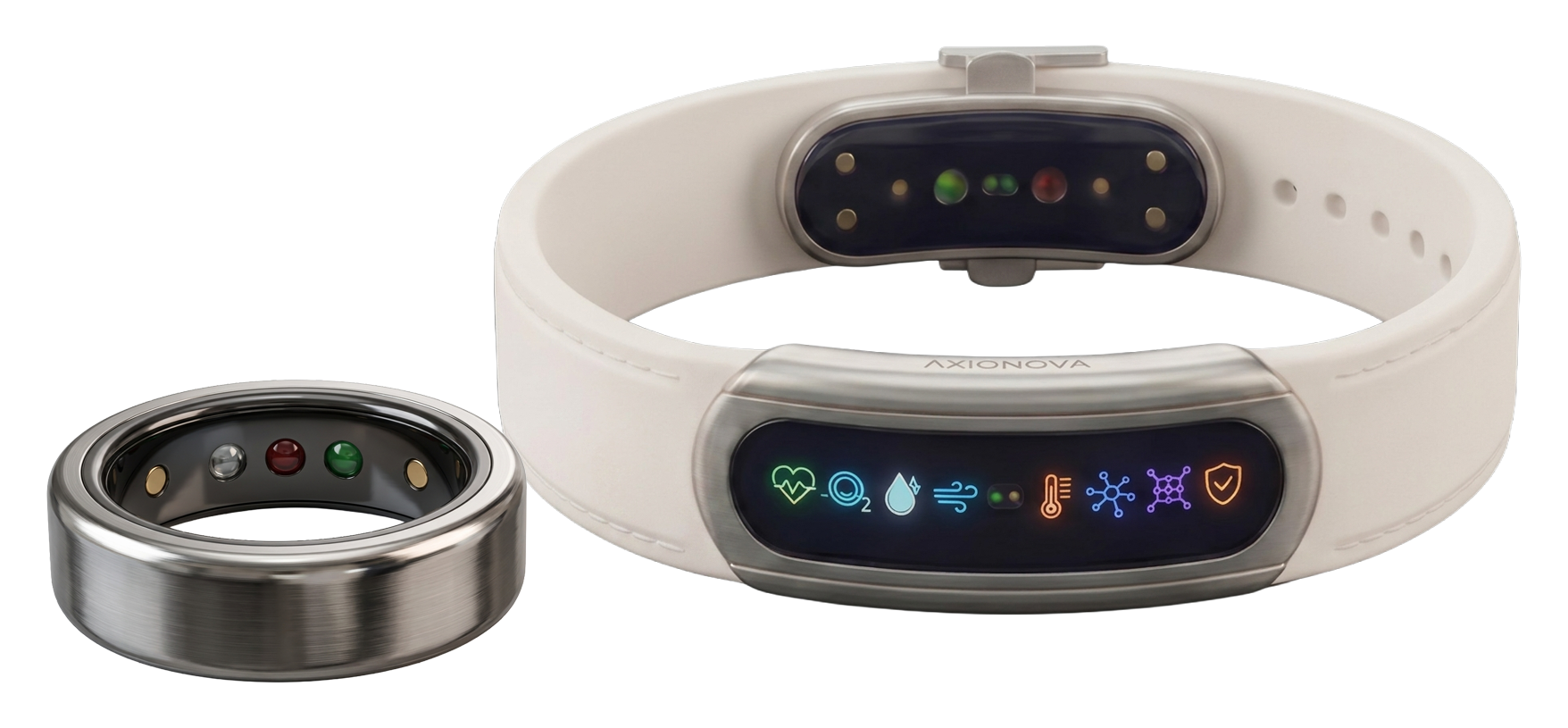
Worn with the AXIONOVA™ Ring on the opposite arm, the bracelet and ring form AXIONOVA™ AGIS: two independent biometric streams that cross-check each other for agreement scoring, anomaly detection, and Digital Twin context. Comparison happens under ALETHRA™ governance before any higher-stakes output is elevated.
Built for professional
oversight.
AXIONOVA™ Bracelet serves clinics, practitioners, longevity centers, and research-oriented programs that need more than consumer-grade tracking. It delivers a continuous, source-labeled stream already aligned with consent, access control, evidence boundaries, and human authority.
Physician-Directed Care: The AXIONOVA™ Bracelet is a specialized instrument within physician-governed clinical protocols. Physiological signals are handled as measured data, trend context, or governed escalation inputs depending on quality, consent, configuration, and human-review requirements. All clinical decisions are made by independent licensed physicians, and the bracelet does not replace qualified medical judgment.
Register for the
AXIONOVA™ Bracelet pathway.
Access is governed by identity, consent, role, jurisdiction, eligibility, and physician-governed clinical protocols.